Showing posts with label Brassey reserve. Show all posts

Friday, 16 March 2018

Can't see 'the water for the trees'

Dense patch of shading on Windrush
Downstream water vole heaven

Initial cuts reveal clear water

Joined GWT at one of my favourite sites today at Brassey on a stretch of the river Windrush  dividing the Hill and Aston farms. John led the team, on a 'remove the shading' task to please the water voles,  downstream of the Brassey reserve. This was a continuation of the work carried out on a stretch of the river Windrush  which included the watercress beds. Given the water levels waders was the order of the day for most of us plus an ability to clear the barb wire fence protecting the riverside from cattle erosion. On Gold cup day at Cheltenham we were blessed with some fine, warm sunny weather. Although previous work had cleared long stretches of overhanging branches the 3 man team I joined had a stretch which was pretty dense. With saw in hand I waded out to attack the willow overshading the water and in spite of a lengthy layoff from this physical work I soon got into a rhythm and gradually made a dent  in the branches revealing the water underneath. It was satisfying to get my feet wet again in one of the river systems here in the Cotswolds. As a bonus the waders I used were free of leaks and the only slight negative was the trudge back up the hilly slope where we had parked the cars.

Friday, 2 June 2017

Monkey pull followed by a gentle kicking!

Good spot on the windrush near Brassy reserve

Innovation at the cattle water station to help calves, nicely modelled  'kick net'

River wind rush, small waterfall from watercress beds

Detailed analysis of 'kick samples'
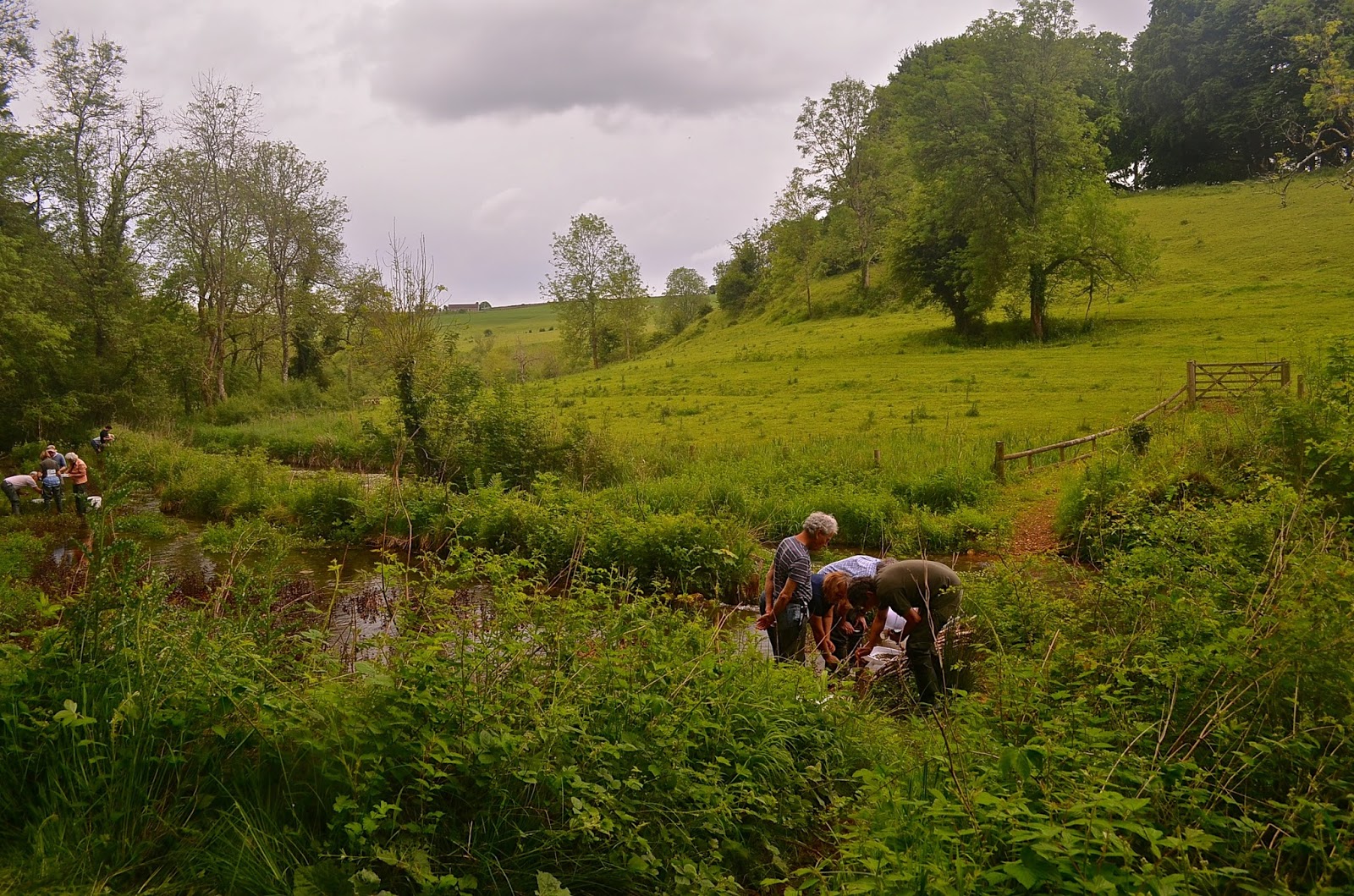
Spent today with GWT at a favourite spot, adjacent to Brassy reserve, the Aston farm watercress beds. The mornings task was to remove Monkey Flower plants and then to carry out some kick sampling to gauge the health {as indicated by micro invertebrates} of the watercress beds which lie alongside the river Windrush. On the way to the beds we passed by a cattle water station where John pointed out an innovation GWT had added to help the calves who were not getting a drink mainly because of their size. At the watercress beds John, task leader {Will joined later}, explained the task  and with waders on we happily stepped  into the cool waterbeds to carefully remove any Monkey flowers plants. Clearly extraction work in previous years had been effective since in just over the hour the Monkey flowers were all removed plus some ash and sycamore saplings which over shadowed the beds. This meant the 'kick sampling' of the waterbeds could begin in earnest with 3 teams of 3/4 each operating along one of three of the watercress beds. The method involved 'gentle kicking' of the water into the sample net at different locations for about one minute duration. The sample was then emptied into a trug before repeating the operation two more times. The contents of the trug was then carefully emptied into white trays containing clear water to allow identification of any micro invertebrates.  Against a list of specific invertebrates a count was carried out. In the sample my team collected ~ 100 shrimp were found along with several  blue winged olive, caddis fly plus an impressive Bull Head fish! Also spotted my first Beautiful Demoiselle of the season. Unfortunately had to leave before full analysis of samples was completed and a 'score' for the waterbeds was given. But on the strength of the sample I was involved with {from probably the 'least healthy looking' area }it should be at least a 6+.

Update on waterbed scores gives a reasonable 5,7 and 9 for each of the waterbeds sampled. Other countryside news this Saturday, on my early morning dog walk, revealed a green woodpecker plus 5 healthy fox cubs happily playing by their den.

Saturday, 14 June 2014

Reflections

Sherborne Hare about to be surprised by me

Mike in Scotland but I still managed a visit to both Sherborne and the Barrington estate with some interesting Hare encounters although the Sherborne badgers were unwilling to put in an appearance for me.

Brassey looking healthy

Brassey mire together with explorer Will

View from the top, shame about the fencing!
Lots of Banded Demoiselle

Good numbers of orchids

Beautiful Demoiselle in even bigger numbers

Friday was spent with the Wildlife Trust on a 'selective' tour of some of the riverside areas worked by volunteers and contractors this year in support of the living landscape programme.  It was an opportunity for reflection on the programme of work carried out this year, in particular, on the riverside environments covering the rivers Windrush, Eye and Dickler {including the Sherborne brook}. Connectivity is a key theme throughout the work and its importance can't be stressed enough. Also a strength of this work has been the collaboration between various organisations {including Cotswold rivers, Wildlife Trust, National Trust, Fishing clubs, Landowners} ably co-ordinated by Wildlife Trust & 'underpinned' by volunteer power. Essential though is achieving the right environment outcomes and sustaining them. So the shrub and invasive plant clearing , river/water management using deflectors, hurdles/faggots to return river width to original boundaries, gravelling to return rivers to natural depths after historic dredging operations,  all need to make a positive difference. The signs look good with for example increasing wildlife numbers {eg.  water voles, otters , fish, birds} , healthy plant life, gradual control over invasive species. Enough of the theory, the day was also about enjoying the fantastic Cotswold environments especially with paddling through the cool water where possible on what proved to be a very hot summers day. Where better to start the tour than Brassey and led by Will & John, with a healthy number of us volunteers, the tour began.  Lots of 'environmental' clearing, removal of invasive plant species and erection of fencing to protect river Windrush banks are all making the right kind of difference. Great area to be in not just for us but a number of heron we accidentally disturbed.

John, testing a deflector on Slaughter farm Windrush

Slaughter farm, good example of  'managing' river course

Slaughter farm Windrush, good work benefits all
Second port of call was at Slaughter Farm by the Windrush where excellent work shrub clearing alongside the Windrush and the 'Oxbow lake' area plus implementation  of deflectors, hurdles for bank reshaping, dipper & kingfisher boxes has been effectively carried out.

Sherborne water meadows, much improved cattle water hole
Final stopping point was at the Sherborne water meadows where its been a busy year on water management and this too was clearly evident with previously dried out water channels with healthy water levels and the river Windrush flows looking healthier with the addition of the 2000 tons of gravel. As a bonus we discovered that one of the owl boxes in the 'tin' barn was occupied by a barn owl. Overall an enjoyable day with John in fine form as 'information' officer with Will in a more relaxed role armed with camera. Only downside on the day were the biting flies, I'm still scratching! and the long hot climb back out of the water meadows.

How many more opportunities can be missed too help support our fragile environment before its too late, lots of responses to Defra's £11B handout to farmers with no 'green' strings attached. Wildlife Trust response pretty representative.

Tuesday, 9 July 2013

All 'brassed off', not at Brassey!

Windrush on the right, waterbeds on left

On the face of it  today with the Wildlife Trust, at the Brassey reserve and nearby Windrush watercress beds, removing Monkey Flower wasn't the most exciting of prospects on yet another scorching day.  Its clearly important to deal with invasive plants so no problem with motivation and given the picturesque waterside environment, we were to work in, a pleasure. As usual the 7 of us volunteers were ably led by Will and John.  Although removing the Monkey Flower was the day's priority the journey down to and along both banks of the Windrush, followed by a walk round the Brassey reserve was a real bonus & full of surprises, especially for me as a first timer in this lovely valley.

5 Spot Burnet moth, 'Brassey' meadow

Southern Marsh orchid, Brassey/Windrush

We started by walking down a steep meadow with plenty of butterflies {ringlets, meadow browns, marble whites}/ moths {day flying 5 Spot Burnet}and flora {especially a good showing of pyramid and common orchids}. We reached the bottom of the valley by a cattle watering hole and disturbed another colourful day flying moth the Cinnabar {a very fetching & noticeable bright 'pink'?}. It was apparent we needed to cross the river Windrush but it was a a little too deep to wade across in wellingtons so we followed the river downstream for a drier crossing place. After the usual climb over a barbed wire fence , then an exciting traverse across a fallen tree and a 'get me out of here' scramble through marshy, thick woodland we arrived at the previously cleared 'waterbed' area where the offending Monkey Flower lay in wait.  Most of us in 'wellies' paddled up and down the shallow water whilst those with waders were able to walk along the adjacent but deeper river Windrush. Just the job on such a hot day and we soon vanquished the invasive plant life. The next task was to move upstream to the Brassey 'mire' reserve to complete the days task.  More interesting flora { Southern Marsh Orchid, Flag iris} and fauna ;a Heron, a frog and yet another moth { Scarlet Tiger}, plus marshy woodland trail were 'enjoyed'. Not a day to be missed and there can't be too many better habitats to help  'fly the flag' of Conservation in.

On a less positive note, the State of Nature report summed up by Mark Avery, provides more depressing Conservation  progress, although not unexpected, especially considering the state of the CAP 'greening' position.  I too like the fact a lot of NGOs {sadly not the NT ?} contributed to it although I agree that habitat isn't stressed enough.

Start of Monkey Flower removal 

Nearly cleared

Downstream from cleared area

Downstream Windrush side